Alright, let’s speak about one thing that is each sensible and extremely helpful: the way to compress a file on Android. Think about your telephone as a bustling metropolis; each picture, doc, and video is a constructing, and cupboard space is the dear actual property. File compression is sort of a magical architect, cleverly reorganizing these “buildings” to make them smaller with out dropping any of their appeal.
It is about maximizing your machine’s capability, making sharing recordsdata a breeze, and usually retaining issues tidy in your digital world. Consider it as a superpower to your telephone – you will be amazed at how a lot house you may reclaim!
We’ll journey via the world of Android file compression, exploring all the pieces from the built-in instruments that include your telephone to the versatile third-party apps accessible within the digital market. We’ll unravel the mysteries of various file codecs, akin to ZIP, RAR, and 7z, and see how they’ll remodel massive recordsdata into neat, compact packages. Alongside the way in which, we’ll uncover the way to squeeze probably the most out of photographs, paperwork, and even movies, guaranteeing you get the very best outcomes.
Whether or not you are a seasoned techie or simply beginning out, this information will equip you with the information and abilities to grasp the artwork of file compression in your Android machine.
Introduction to File Compression on Android
File compression in your Android machine is like packing your suitcase strategically earlier than a visit. You are taking cumbersome objects and discovering methods to make them smaller with out dropping any of their important options. This course of frees up house and makes all the pieces run a bit of smoother, similar to having extra room in your baggage for souvenirs.
Understanding File Compression Fundamentals
File compression entails lowering the scale of a file, sometimes by eradicating redundant data or utilizing extra environment friendly methods to retailer the information. Which means a big file may be shrunk right down to a smaller dimension with out considerably affecting its high quality. Consider it like folding a big t-shirt; it takes up much less house in your drawer however nonetheless stays a superbly wearable shirt.
Advantages of File Compression for Android Customers
Android customers can expertise a number of benefits when using file compression. It is akin to having a super-powered digital assistant optimizing your machine.
- Saving Storage House: Compressing recordsdata instantly interprets to extra accessible storage in your machine. That is notably useful on Android units with restricted inside storage or these with many massive recordsdata like pictures and movies. That is akin to the aid of lastly cleansing out that overflowing closet.
- Quicker Sharing: Smaller file sizes imply faster uploads and downloads. When sharing recordsdata with buddies or colleagues, compressed recordsdata are transferred a lot sooner, resulting in a extra streamlined expertise. Contemplate it the equal of a quick lane on the digital freeway.
- Lowered Knowledge Utilization: Whenever you add or obtain recordsdata over a cell community, smaller recordsdata imply much less knowledge consumed. That is particularly helpful for customers with restricted knowledge plans.
Widespread File Varieties That Profit Most From Compression
Sure file sorts are notably well-suited for compression, yielding important house financial savings and effectivity positive factors.
- Photos (JPEG, PNG, GIF): Picture recordsdata usually include redundant knowledge that may be eliminated throughout compression. JPEG recordsdata, as an illustration, are recognized for his or her lossy compression, which implies some knowledge is discarded to scale back file dimension. An image of a sundown may be compressed considerably with no noticeable loss in visible high quality.
- Paperwork (DOCX, PDF, TXT): Textual content-based paperwork may be compressed very successfully. Trendy doc codecs, like DOCX, already make use of some degree of compression. PDF recordsdata, particularly these with embedded photographs, also can profit from compression. Think about squeezing a thick novel right into a slim quantity.
- Archives (ZIP, RAR): Archive recordsdata are particularly designed for compression. They bundle a number of recordsdata right into a single, smaller package deal. That is like combining a number of particular person receipts right into a single, organized folder.
- Movies (MP4, MOV): Video recordsdata may be compressed, however the diploma of compression can have an effect on video high quality. Video compression usually entails eradicating redundant frames or knowledge.
Actual-World Examples of Compression in Motion
Contemplate a situation the place you have taken a whole lot of pictures in your Android telephone throughout a trip. Every high-resolution picture is likely to be a number of megabytes in dimension. By compressing these pictures utilizing an app or function in your telephone, you possibly can scale back the scale of every picture to a fraction of its authentic dimension.Think about, as an illustration, that you’ve got a folder of 500 pictures, every averaging 5MB.
Uncompressed, these pictures would occupy 2.5GB of storage. In the event you compress these pictures utilizing an appropriate technique and scale back their common dimension to 1MB, you’ll release 2GB of house. It is a important acquire, particularly on units with restricted storage. This additionally interprets to sooner uploads to cloud storage or sharing with family and friends.
Strategies for Compressing Recordsdata on Android
File compression in your Android machine is a unbelievable approach to save house and make it simpler to share recordsdata. Whether or not you are attempting to squeeze a number of extra pictures onto your telephone or ship a big video to a buddy, understanding the totally different strategies accessible is vital. Let’s dive into the choices you might have at your fingertips.
Constructed-in File Managers with Compression Capabilities
Many Android units come outfitted with a built-in file supervisor, a helpful software for navigating your storage. A few of these file managers provide compression functionalities, offering a handy approach to zip and unzip recordsdata instantly in your machine. These built-in instruments can fluctuate in options and capabilities relying on the producer and the Android model. Nonetheless, the core performance stays the identical: to scale back file dimension for simpler administration and sharing.
- The way to Use: Usually, you will open your file supervisor, navigate to the file or folder you need to compress, and long-press it. This motion normally brings up a context menu with choices like “Compress,” “Zip,” or “Extract.” Choose the suitable choice, and the file supervisor will create a compressed archive.
- Professionals: The primary benefit is comfort. It is pre-installed, so there is not any have to obtain something. It is normally simple to make use of, making it accessible to customers of all technical ranges.
- Cons: Constructed-in file managers usually have restricted options in comparison with devoted third-party apps. They could help fewer compression codecs and might be slower at compressing bigger recordsdata. The compression ratio won’t be as environment friendly as what you possibly can obtain with a specialised app.
- Instance: Think about you are attempting to ship a big picture album to a buddy. Utilizing your built-in file supervisor, you may choose your entire folder, compress it right into a ZIP file, after which simply share the only, smaller file. This simplifies the method in comparison with sending every picture individually.
Utilizing Third-Social gathering Apps for File Compression
For extra superior compression choices and higher management, third-party apps are your finest guess. The Google Play Retailer is brimming with file compression apps, every providing a novel set of options and capabilities. These apps usually present help for a wider vary of compression codecs, higher compression ratios, and extra options like password safety.
- Fashionable Apps: Among the hottest apps embody ZArchiver, RAR, and 7Zipper. These apps usually provide a user-friendly interface and help for varied codecs akin to ZIP, RAR, 7z, and others.
- Options: Past primary compression, these apps usually embody options like:
- Password safety to your archives.
- File extraction capabilities for varied codecs.
- The flexibility to separate massive archives into smaller elements for simpler sharing.
- Background compression, permitting you to proceed utilizing your machine whereas the app works.
- The way to Select: When choosing a third-party app, take into account the next:
- Supported Codecs: Does it help the codecs you want (ZIP, RAR, 7z, and many others.)?
- Ease of Use: Is the interface intuitive and simple to navigate?
- Compression Ratio: Does it provide environment friendly compression?
- Options: Does it provide extra options like password safety or archive splitting?
- Critiques and Scores: Examine consumer evaluations to gauge the app’s reliability and efficiency.
- Professionals: Third-party apps usually provide higher compression ratios, help for a wider vary of codecs, and extra superior options than built-in file managers.
- Cons: You may have to obtain and set up an app, and a few apps could include adverts or require in-app purchases for full performance.
- Instance: For example you are backing up your telephone’s knowledge. Utilizing a third-party app like ZArchiver, you possibly can create a password-protected 7z archive of your pictures, movies, and paperwork, guaranteeing the information is each compressed and safe.
Comparability of Compression Strategies
Choosing the proper technique for compressing recordsdata depends upon your particular wants. The next desk supplies a transparent comparability of the totally different compression strategies, highlighting their ease of use, compression ratio, and supported file sorts.
| Methodology | Ease of Use | Compression Ratio | Supported File Varieties |
|---|---|---|---|
| Constructed-in File Supervisor | Straightforward (usually simple interface) | Average (varies relying on the file supervisor) | Primarily ZIP |
| Third-Social gathering Apps | Average to Straightforward (relying on the app) | Good to Wonderful (usually increased than built-in managers) | ZIP, RAR, 7z, and others (relying on the app) |
Utilizing Constructed-in File Managers for Compression
Android, your pocket-sized portal to digital wonders, usually comes outfitted with a secret weapon for file administration: the built-in file supervisor. Consider it as your machine’s inside librarian, organizing and managing your digital treasures. This part will information you thru the ins and outs of this helpful software, revealing the way it can effortlessly compress and decompress your recordsdata, all with out requiring any additional apps.
Finding and Utilizing the Constructed-in File Supervisor
Discovering the file supervisor in your Android machine is akin to a treasure hunt, however worry not, the clues are normally simple. The situation of the file supervisor varies barely relying on the producer and Android model, however right here’s a basic roadmap:
- The App Drawer: That is your main looking floor. Swipe up from the underside of your display (or faucet the app drawer icon, usually a grid of dots or squares) to disclose all put in apps. Search for an app named “Recordsdata,” “File Supervisor,” “My Recordsdata,” or one thing related.
- Pre-installed Apps: Many Android units include a file supervisor pre-installed. Examine your house display and app drawer for any of the aforementioned names.
- Settings Menu: In the event you’re nonetheless misplaced, enterprise into your machine’s settings. Seek for “Recordsdata” or “Storage” to see if a file supervisor is accessible via that route.
- Producer Variations: Samsung units regularly have “My Recordsdata,” whereas Google Pixel telephones usually use “Recordsdata by Google” (which, though downloadable from the Play Retailer, is likely to be pre-installed). Different producers like Xiaomi, OnePlus, and Huawei have their very own proprietary file managers with distinctive names and interfaces.
As soon as you have situated the file supervisor, opening it is so simple as tapping its icon. The interface sometimes presents a hierarchical view of your storage, with folders representing totally different areas like inside storage, SD card (if relevant), downloads, and extra. That is your digital command heart.
Step-by-Step Compression and Extraction
Now, let’s get right down to enterprise and compress these recordsdata. Utilizing your built-in file supervisor, the method is surprisingly easy:
- Navigate to the Recordsdata: Open the file supervisor and browse to the situation of the recordsdata or folders you need to compress. This might be in your “Downloads” folder, your “Footage” folder, or wherever else you have saved them.
- Choose the Recordsdata/Folders: Lengthy-press on a file or folder to pick out it. You possibly can then faucet on different recordsdata or folders to pick out a number of objects. Some file managers let you choose all objects in a folder utilizing a “Choose All” choice.
- Provoke Compression: Search for an choice to compress the chosen recordsdata or folders. This is likely to be a menu icon (three vertical dots), a context menu (showing after long-pressing), or a button labeled “Compress,” “Zip,” or “Archive.” The precise wording varies, however the performance is constant.
- Title the Archive: You may normally be prompted to present your compressed file a reputation. That is the title of the .zip file that can be created. Select a descriptive title that will help you determine the contents later.
- Begin the Compression: Faucet “OK” or “Compress” (or the equal button) to start the compression course of. The time it takes will rely on the scale and variety of recordsdata. You may possible see a progress bar.
- Find the Compressed File: As soon as the compression is full, the .zip file can be created in the identical location as the unique recordsdata or folders.
Extracting the compressed file is simply as simple:
- Find the .zip File: Open the file supervisor and navigate to the situation of the .zip file.
- Choose the .zip File: Faucet on the .zip file.
- Provoke Extraction: A menu will normally pop up with an choice like “Extract,” “Unzip,” or “Extract All.”
- Select the Vacation spot: You is likely to be prompted to decide on the place you need to extract the recordsdata. The default is usually the identical location because the .zip file.
- Begin the Extraction: Faucet “Extract” or “Unzip” to start the extraction course of.
- Entry the Extracted Recordsdata: The extracted recordsdata or folders will now be accessible within the chosen vacation spot.
Troubleshooting Widespread Points
Even with an easy course of, you would possibly encounter a number of hiccups. This is the way to navigate them:
- Compression Choice Lacking: If you cannot discover a compression choice, double-check that you simply’re utilizing the built-in file supervisor and never a third-party app. Additionally, guarantee you might have the most recent model of the file supervisor put in (examine the Google Play Retailer). Some older Android variations could not help native compression.
- Extraction Errors: Extraction errors can happen if the .zip file is corrupted or incomplete. Attempt re-downloading the file or, if you happen to created the .zip file, re-compressing it. Guarantee you might have sufficient cupboard space accessible for the extracted recordsdata.
- Gradual Compression/Extraction: Giant recordsdata or folders can take some time to compress or extract. Keep away from interrupting the method. If it is constantly sluggish, take into account the age of your machine and the velocity of your storage (e.g., an older SD card is likely to be slower).
- Unsupported File Varieties: Whereas .zip is the commonest format, some file managers could not help all compression codecs. In the event you’re coping with a special archive format (e.g., .rar), it’s possible you’ll want a third-party app like “RAR for Android” or “ZArchiver.”
- Inadequate Storage House: It is a frequent subject. Earlier than extracting, be sure to have sufficient free house in your machine. The extracted recordsdata will take up extra space than the compressed archive.
Bear in mind, the built-in file supervisor is a robust software, and with a bit of observe, you will be zipping and unzipping recordsdata like a professional.
Using Third-Social gathering Apps for Compression: How To Compress A File On Android
Whereas Android’s built-in instruments provide primary file compression, typically you want a bit of extra oomph. Third-party apps can present superior options, broader format help, and a extra streamlined expertise. They’re just like the seasoned execs within the file compression sport, able to sort out any problem you throw their means.
Design for Deciding on Appropriate Third-Social gathering File Compression Apps
Choosing the proper app is essential. Consider it like choosing the right software for a selected job. You would not use a hammer to tighten a screw, would you? The choice course of must be approached methodically, guaranteeing the app meets your wants and aligns along with your workflow.Contemplate the next components when choosing a third-party file compression app:
- Person Critiques and Scores: Earlier than committing, flick through consumer evaluations and examine the app’s general ranking. This supplies perception into the app’s reliability, ease of use, and any potential points. A excessive ranking and constructive suggestions from different customers usually point out a reliable app.
- Permissions Required: Scrutinize the permissions the app requests. Be cautious of apps that request extreme or pointless permissions, akin to entry to your contacts or location if they’re unrelated to file compression.
- Developer Popularity: Analysis the app developer. Examine their monitor document and see if they’ve a historical past of releasing dependable and safe apps. Respected builders usually present higher help and updates.
- Format Assist: Make sure the app helps the file codecs you regularly work with, akin to ZIP, RAR, 7z, and others. In the event you work with much less frequent codecs, verify the app’s compatibility.
- Ease of Use: The app’s interface must be intuitive and simple to navigate. A user-friendly design will prevent time and frustration. Search for apps with clear directions and useful options.
- Further Options: Contemplate any additional options that is likely to be helpful, akin to password safety, file splitting, or background compression.
Options to Search for in a Third-Social gathering Compression App
A very good compression app is not nearly shrinking recordsdata; it is about offering a complete suite of instruments to handle your digital life effectively. Search for apps that supply a stability of performance, safety, and ease of use.Listed below are key options to prioritize:
- Format Assist: The app ought to help a variety of compression codecs, together with ZIP, RAR, 7z, and probably others like TAR, GZIP, and BZIP2. This ensures compatibility with recordsdata from varied sources.
- Batch Compression: The flexibility to compress a number of recordsdata or folders concurrently is a serious time-saver. This function permits you to course of massive portions of knowledge with minimal effort.
- Password Safety: For delicate recordsdata, password safety is crucial. Search for apps that supply sturdy encryption algorithms to safeguard your knowledge.
- File Splitting: This function permits you to divide massive recordsdata into smaller elements, which may be helpful for sharing recordsdata by way of e mail or transferring them to units with storage limitations.
- File Extraction: The app ought to simply extract compressed recordsdata in varied codecs.
- Preview Performance: Some apps let you preview the contents of an archive earlier than extracting it. This may be useful to make sure you’re extracting the proper recordsdata.
- Integration with Cloud Storage: Some apps combine with cloud storage companies like Google Drive, Dropbox, or OneDrive. This lets you compress and handle recordsdata instantly from the cloud.
- Background Compression: The flexibility to compress recordsdata within the background, permitting you to proceed utilizing your machine with out interruption, is a big benefit.
- File Administration Options: Further file administration instruments, akin to the power to repeat, transfer, and delete recordsdata, may be helpful for organizing your recordsdata.
Downloading, Putting in, and Utilizing a Fashionable Third-Social gathering Compression App (e.g., ZArchiver)
ZArchiver is a well-liked and free file archiver app for Android, recognized for its intensive format help and user-friendly interface. It is an amazing instance of a strong compression software.This is the way to obtain, set up, and get began with ZArchiver:
- Downloading and Set up:
- Open the Google Play Retailer in your Android machine.
- Seek for “ZArchiver.”
- Faucet on the ZArchiver app (normally recognized by a “Z” icon).
- Faucet the “Set up” button.
- As soon as the set up is full, faucet the “Open” button to launch the app.
- Interface Overview:
- The ZArchiver interface resembles a file explorer. It shows your machine’s file system, permitting you to navigate to the recordsdata and folders you need to compress.
- The primary window shows the basis listing. You possibly can flick through your storage and discover the file you want.
- Granting Permissions:
- Whenever you first open ZArchiver, it’s going to request permission to entry your machine’s storage. Grant the mandatory permissions to permit the app to perform.
Steps for Compressing a File Utilizing the Chosen App
Compressing recordsdata with ZArchiver is easy. This is a step-by-step information:
- Navigate to the File: Open ZArchiver and navigate to the situation of the file or folder you need to compress. Use the file explorer to search out it.
- Choose the File: Faucet and maintain on the file or folder you need to compress. This can open a context menu.
- Select “Compress”: From the context menu, choose the “Compress” choice (normally represented by an archive icon).
- Configure Compression Settings: A dialog field will seem, permitting you to customise the compression settings.
- Archive Format: Select the specified archive format (e.g., ZIP, 7z, tar). ZIP is a standard and broadly appropriate format.
- Compression Degree: Choose the compression degree. Increased compression ranges lead to smaller file sizes however take longer to compress. Think about using “Quick” or “Regular” for basic use.
- Password Safety (Elective): If you wish to password-protect the archive, enter a password within the “Password” area.
- Archive Title: You possibly can rename the archive file by typing the brand new title within the “Archive title” area.
- Begin Compression: Faucet the “OK” button to start the compression course of. ZArchiver will show a progress bar. The time it takes will rely on the file dimension and compression settings.
- Discover the Compressed File: As soon as the compression is full, the compressed file will seem in the identical listing as the unique file. The file title would be the identical as the unique, with the suitable extension (e.g., .zip, .7z).
Steps for Extracting Compressed Recordsdata Utilizing the Similar App
Extracting recordsdata with ZArchiver is equally simple. This is how:
- Find the Compressed File: Open ZArchiver and navigate to the situation of the compressed file (e.g., a ZIP or RAR file).
- Choose the Compressed File: Faucet on the compressed file. A context menu will seem.
- Select “Extract”: Choose the “Extract” choice from the menu.
- Select Extraction Vacation spot: ZArchiver will immediate you to decide on the place to extract the recordsdata. You possibly can browse to a special listing or use the default location.
- Enter Password (if required): If the archive is password-protected, enter the password when prompted.
- Begin Extraction: Faucet the “OK” button to start the extraction course of. ZArchiver will show a progress bar.
- Entry Extracted Recordsdata: As soon as the extraction is full, the extracted recordsdata can be situated within the vacation spot folder you chose.
Supported File Codecs and Compression Algorithms
Alright, let’s dive into the nitty-gritty of what file codecs and compression algorithms Android compression instruments sometimes help. Understanding these is vital to selecting the best software and technique for the job, guaranteeing you get the very best outcomes. Consider it like this: you would not use a hammer to screw in a screw, proper? Similar precept applies right here!
Widespread File Codecs
Android’s compression instruments are fairly versatile, dealing with a wide range of file codecs. The selection of format usually dictates the extent of compression and compatibility throughout totally different units and working programs. The commonest codecs are designed to be user-friendly, providing a stability between compression effectivity and ease of use.The next codecs are regularly encountered:
- ZIP: That is the workhorse of Android compression. It is universally supported, making it a secure guess for sharing recordsdata with others. Consider it because the Swiss Military knife of compression: dependable, broadly appropriate, and usually efficient.
- RAR: Whereas not as universally supported as ZIP, RAR provides usually higher compression ratios and is usually used for archiving massive recordsdata or bundles. Nonetheless, you would possibly want a devoted app to decompress RAR recordsdata.
- 7z: Identified for its excessive compression ratios, 7z is a robust format that’s usually favored for archiving and backing up massive quantities of knowledge. It additionally helps sturdy encryption for added safety. Nonetheless, it’s not as broadly appropriate as ZIP, so take into account your viewers earlier than utilizing it.
Compression Algorithms: The Engines of Effectivity
Compression algorithms are the key sauce behind making recordsdata smaller. They analyze the information inside a file and apply varied strategies to scale back its dimension. Totally different algorithms excel in numerous conditions, so understanding their strengths and weaknesses may help you make knowledgeable decisions.This is a take a look at some frequent algorithms:
- Deflate: That is the algorithm mostly utilized by ZIP. It is a lossless compression algorithm, which means no knowledge is misplaced throughout compression and decompression. Deflate is usually a very good all-rounder, providing an honest stability between compression ratio and velocity.
- Bzip2: Identified for its increased compression ratios than Deflate, Bzip2 is especially efficient for compressing textual content and supply code. It’s slower than Deflate, nevertheless, which means the compression course of takes longer.
- LZMA: Utilized by 7z, LZMA is thought for offering very excessive compression ratios. It is usually slower than each Deflate and Bzip2, however the house financial savings may be important, particularly for giant recordsdata.
Selecting the Proper Format and Algorithm
Deciding on the best format and algorithm depends upon the kind of recordsdata you’re compressing and your priorities. Do you want most compression, or is velocity and compatibility extra necessary?Contemplate these factors:
- For Paperwork and Textual content Recordsdata: Bzip2 or LZMA (inside a 7z archive) may be glorious decisions as a consequence of their sturdy efficiency on text-based knowledge.
- For Photos and Multimedia: ZIP is a stable selection for archiving photographs, although the compression ratio won’t be as excessive as with different codecs. In the event you want increased compression, think about using specialised picture compression instruments
-before* archiving. - For Software program and Giant Recordsdata: 7z, utilizing the LZMA algorithm, is usually a nice choice for attaining one of the best compression ratio, particularly when cupboard space is at a premium.
Compression Ratio Examples (ZIP Format)
The compression ratio represents how a lot the file dimension is diminished. It’s normally expressed as a share or a ratio. Take into account that these are simply examples; the precise compression ratio can fluctuate relying on the precise file and the settings used.Listed below are some compression ratio examples utilizing the ZIP format:
- Textual content Paperwork (.txt): Compression ratio: 70-80%. Instance: A 10MB textual content file would possibly compress right down to 2-3MB.
- Spreadsheets (.xls, .xlsx): Compression ratio: 40-60%. Instance: A 50MB spreadsheet would possibly compress right down to 20-30MB.
- Photos (.jpg, .png): Compression ratio: 10-30% (relying on the picture kind and pre-compression). Instance: A 10MB picture would possibly compress right down to 7-9MB. Observe that photographs are sometimes already compressed utilizing their very own algorithms (like JPEG).
- Audio Recordsdata (.mp3): Compression ratio: Little or no compression doable, and even enhance in dimension. Instance: A 10MB MP3 file would possibly compress right down to 9.8MB (negligible). Audio recordsdata are normally already compressed.
- Video Recordsdata (.mp4, .mov): Compression ratio: Little or no compression doable, and even enhance in dimension. Instance: A 100MB video file would possibly compress right down to 98MB (negligible). Video recordsdata are normally already compressed.
- Archive Recordsdata (.zip, .rar): Compression ratio: Will depend on the contents of the archive. Instance: A 100MB archive containing largely textual content recordsdata would possibly compress right down to 30-40MB.
Compressing Particular File Varieties
Alright, buckle up, buttercups! Now we’re diving deep into the nitty-gritty of compressing particular file sorts in your Android machine. It is like a digital spring cleansing, however as a substitute of decluttering your closet, you are streamlining your cupboard space. This part will arm you with the information to squeeze each final byte out of your treasured recordsdata, making room for extra cat movies, trip snaps, and productiveness apps.
Put together to turn into a compression ninja!
Compressing Photos on Android to Save House With out Important High quality Loss
Photos, the silent hoarders of your telephone’s reminiscence, usually hog probably the most house. Fortunately, there are methods to shrink them down with out turning your cherished pictures into pixelated messes. The secret’s to search out the candy spot between file dimension and visible constancy.This is the lowdown on attaining picture compression nirvana:
- Understanding Picture Compression: It entails lowering the file dimension by eradicating redundant knowledge. Lossy compression, like JPEG, discards some knowledge, however the loss is usually imperceptible to the bare eye. Lossless compression, like PNG, preserves all knowledge, leading to bigger recordsdata.
- Utilizing Constructed-in Options (If Out there): Some Android telephones provide built-in picture compression choices of their gallery apps or digital camera settings. Search for choices like “resize,” “optimize,” or “save as a smaller file.” That is the best approach to compress photographs.
- Using Third-Social gathering Apps: Apps like “Picture Compressor” and “Picture & Image Resizer” are your finest buddies. They let you choose the compression degree, usually utilizing a slider to stability high quality and dimension. Experiment to search out the right setting for every picture.
- JPEG vs. PNG: JPEG is usually higher for pictures, because it provides glorious compression. PNG is most popular for photographs with sharp traces, textual content, or transparency.
- Really useful Settings: For JPEG photographs, purpose for a compression degree that reduces the file dimension by 50-80% with out noticeable high quality loss. The precise worth depends upon the picture content material and your private desire.
For example, take into account a household picture initially taking over 5MB of storage. Utilizing a compression app with a JPEG setting and a compression degree of 70%, the identical picture is likely to be diminished to round 1.5MB, with minimal visible variations. This might release a big quantity of house, particularly when you’ve got a whole lot or hundreds of pictures.
Explaining The way to Compress Paperwork (e.g., PDFs, Phrase paperwork) on Android
Paperwork, the unsung heroes of our digital lives, also can profit from a little bit of slimming down. PDFs and Phrase paperwork, particularly, may be surprisingly massive, particularly these stuffed with photographs or complicated formatting. This is the way to whip them into form.This is the sport plan for doc compression:
- PDF Compression: The commonest strategy entails lowering picture decision throughout the PDF. It’s also possible to take away pointless fonts, and compress the doc’s construction.
- Phrase Doc Compression: Just like PDFs, the main target is on lowering picture decision and eradicating embedded fonts. Moreover, it can save you the doc in a extra environment friendly format, such because the older .doc format if backward compatibility shouldn’t be a problem, or use the “compress footage” function.
- Apps for the Job: Apps like “PDF Compressor” and “Compress PDF” are available on the Google Play Retailer. These apps usually let you specify the compression degree, focusing on a stability between file dimension and readability. For Phrase paperwork, think about using a doc editor app that gives compression choices, or saving the file in a special format.
- Selecting the Proper Settings: For PDFs, experiment with totally different picture decision settings. Decreasing the decision to 150-200 DPI usually supplies a very good stability. For Phrase paperwork, scale back the picture dimension to an acceptable worth or select the compression choice supplied within the app.
Think about you might have a PDF report with quite a few high-resolution photographs, taking over 20MB. Utilizing a PDF compression app with a average compression setting, you would possibly shrink it right down to 5-7MB, considerably enhancing the power to share and retailer the doc with no notable degradation in picture high quality for the end-user.
Describing The way to Compress Movies on Android
Movies, the final word reminiscence hogs, can rapidly refill your storage. Compressing movies is a little more complicated than compressing photographs or paperwork, however the advantages are properly well worth the effort.Right here’s the way to trim these video recordsdata right down to dimension:
- Video Compression Fundamentals: Video compression works by lowering the body price, decision, or bitrate (the quantity of knowledge used to encode the video per second). Lossy compression is nearly at all times used, which sacrifices some visible data to scale back file dimension.
- Utilizing Video Compression Apps: A number of apps focus on video compression. Fashionable decisions embody “Video Compressor,” “Video Compress & Resize,” and “Sensible Video Compressor.” These apps let you regulate decision, body price, and bitrate.
- Selecting the Proper Settings: The optimum settings rely on the video’s authentic high quality and your required end result. This is a basic guideline:
- Decision: Scale back the decision if the video shouldn’t be supposed for giant screens. Dropping from 1080p (1920×1080) to 720p (1280×720) can considerably scale back the file dimension.
- Body Charge: Until the video has quick movement, lowering the body price to 24 or 25 frames per second (fps) may help.
- Bitrate: That is probably the most essential setting. Decreasing the bitrate reduces the file dimension, however it may well additionally have an effect on the video’s high quality. Experiment to search out the bottom bitrate that also seems acceptable.
- Testing and Experimentation: The most effective strategy is to experiment with totally different settings on a small portion of a video earlier than compressing your entire file. This lets you assess the standard loss and select the optimum configuration.
For instance, suppose you might have a 4K video clip that takes up 500MB. By lowering the decision to 1080p, reducing the body price to 24fps, and adjusting the bitrate, you would possibly scale back the file dimension to 150MB or much less, with no dramatic loss in visible constancy for many viewers. This might be an enormous house saver!
Demonstrating the Use of Particular Apps or Strategies for Every File Sort
Let’s get sensible. This is a fast run-through utilizing some in style apps for every file kind:
- Picture Compression:
- App: “Picture Compressor” (accessible on Google Play Retailer).
- Steps: Open the app, choose the picture, select a compression degree (e.g., “Medium” or “Excessive”), and save the compressed picture.
- Instance: Compressing a 3MB JPEG picture to roughly 800KB.
- Doc Compression (PDF):
- App: “PDF Compressor” (accessible on Google Play Retailer).
- Steps: Open the app, choose the PDF, select a compression setting (e.g., “Low,” “Medium,” or “Excessive”), and save the compressed PDF.
- Instance: Compressing a 15MB PDF report back to roughly 4MB.
- Video Compression:
- App: “Video Compressor” (accessible on Google Play Retailer).
- Steps: Open the app, choose the video, select a compression preset (e.g., “Small file” or “Customized”), or regulate decision, body price, and bitrate manually. Save the compressed video.
- Instance: Compressing a 200MB 1080p video to roughly 50MB.
These are simply examples, and the precise steps and outcomes could fluctuate relying on the app and the unique file. The secret’s to experiment and discover what works finest to your wants.
Creating an HTML Desk with 4 Responsive Columns Detailing the Finest Compression Settings for Photos, Paperwork, and Movies
This is a helpful desk to information you thru the compression course of:
| File Sort | Really useful Settings | Apps to Use | Anticipated Consequence |
|---|---|---|---|
| Photos (JPEG) | Compression Degree: 60-80% (relying on the picture and desired high quality). Decision: Retain authentic or barely scale back if wanted. | Picture Compressor, Picture & Image Resizer, built-in gallery app options | File dimension discount of 50-80% with minimal high quality loss. Instance: 4MB picture diminished to 1MB. |
| Photos (PNG) | Compression: Lossless compression. Contemplate lowering the colour depth if doable (e.g., from 24-bit to 8-bit). | Picture Compressor, built-in gallery app options | Average file dimension discount. The discount depends upon the unique picture, which is usually lower than with JPEG compression. Instance: 2MB picture diminished to 1.5MB. |
| Paperwork (PDF) | Picture Decision: 150-200 DPI. Take away pointless fonts. Compress the doc construction. | PDF Compressor, Compress PDF | File dimension discount of 40-70%. Instance: 10MB PDF diminished to 3MB. |
| Paperwork (Phrase) | Scale back picture decision. Take away embedded fonts. Use the “compress footage” function. | Doc editor apps with compression options. | File dimension discount of 30-60%. Instance: 5MB Phrase doc diminished to 2MB. |
| Movies | Decision: Scale back to 720p or decrease if the unique is increased. Body Charge: 24-30 fps. Bitrate: Experiment to search out the bottom acceptable worth (e.g., 1-5 Mbps for 720p, 2-8 Mbps for 1080p). | Video Compressor, Video Compress & Resize, Sensible Video Compressor | Important file dimension discount (usually 50-80%). Instance: 200MB video diminished to 50MB. |
Safety and Privateness Issues

Compressing recordsdata in your Android machine is a unbelievable approach to save house and manage your digital life. Nonetheless, it is essential to know the safety and privateness implications that include it. Consider it like packing your valuables right into a suitcase – you need to ensure it is safe, so nothing will get misplaced or, worse, stolen. This part dives into how to make sure your compressed recordsdata are secure from prying eyes and potential knowledge breaches.
Safety Implications of Compressing and Extracting Recordsdata on Android
The method of compressing and extracting recordsdata, whereas usually secure, does current potential safety vulnerabilities. Whenever you compress a file, you are basically gathering all the information into one package deal. Equally, when extracting, you are releasing that package deal. Each actions may be vectors for safety threats if not dealt with rigorously.
- Malware Propagation: If a compressed file incorporates malware (like a virus or trojan), the compression course of can inadvertently assist unfold it. Compressing the contaminated file basically wraps up the menace, making it simpler to share and probably infect different units. When the file is extracted, the malware is launched, probably inflicting injury to the system or stealing delicate data.
- Knowledge Breaches: Compressed recordsdata containing delicate data (e.g., monetary information, private knowledge) are in danger if the compression course of is not safe. If a compression app has vulnerabilities, a malicious actor may exploit them to entry the contents of the compressed file.
- Unsecured Extraction: Extracting recordsdata from an untrusted supply can expose your machine to malware. The extraction course of itself may be exploited if the app dealing with the extraction shouldn’t be safe, resulting in the set up of malicious software program.
- Metadata Publicity: Compression codecs can typically retain metadata (details about the file, akin to creation date, writer, and many others.). This metadata, if not correctly managed, may inadvertently reveal delicate details about the recordsdata and their origins. For instance, a compressed picture file would possibly retain location knowledge, probably revealing the place the image was taken.
Defending Compressed Recordsdata with Passwords
Among the finest methods to safe your compressed recordsdata is by utilizing password safety. This provides an additional layer of protection, making it a lot more durable for unauthorized people to entry your knowledge. It is like having a lock in your suitcase – solely these with the important thing (the password) can open it.
- Password-Protected Compression: Most compression apps provide the choice to set a password throughout the compression course of. This encrypts the contents of the compressed file, in order that solely somebody with the proper password can extract and consider the recordsdata.
- Robust Password Practices: Selecting a powerful password is paramount. A powerful password is:
- Not less than 12 characters lengthy.
- Contains a mixture of uppercase and lowercase letters, numbers, and symbols.
- Shouldn’t be simply guessable (e.g., avoids private data like birthdays or names).
Keep away from utilizing frequent passwords like “password123” or “123456.” Think about using a password supervisor to generate and retailer sturdy, distinctive passwords.
- Common Password Updates: In the event you suspect your password has been compromised or if you wish to keep optimum safety, change your password periodically.
Suggestions for Selecting Safe Compression Apps
The safety of your compressed recordsdata largely depends upon the compression app you select. Not all apps are created equal; some could have vulnerabilities or lack security measures. Selecting a safe app is like choosing a reliable locksmith – you need somebody dependable to deal with your priceless knowledge.
- Analysis and Critiques: Earlier than putting in any compression app, analysis its status. Learn evaluations from different customers and search for stories of safety vulnerabilities or privateness issues.
- Developer Popularity: Examine the developer’s background. Are they a good firm or particular person? Have they got a historical past of growing safe and dependable apps?
- Permissions: Fastidiously overview the permissions the app requests. Does it want entry to your contacts, location, or different delicate knowledge that appears pointless for compression? In that case, rethink utilizing the app.
- Encryption Capabilities: Make sure the app provides sturdy encryption choices, akin to AES-256 encryption. It is a strong encryption customary that protects your recordsdata from unauthorized entry.
- Updates and Assist: Select an app that’s commonly up to date to deal with safety vulnerabilities. The developer also needs to present buyer help in case you encounter any points.
- Examples of Safe Compression Apps: A number of well-regarded compression apps for Android are recognized for his or her security measures. Examples embody (however are usually not restricted to) apps like “ZArchiver” and “RAR for Android” that supply password safety and encryption choices. At all times confirm the app’s security measures and skim consumer evaluations earlier than utilizing any compression utility.
Finest Practices for Dealing with Delicate Recordsdata Throughout Compression, The way to compress a file on android
Even with one of the best safety measures in place, it is best to observe some finest practices when dealing with delicate recordsdata throughout compression. This ensures that your knowledge stays as safe as doable. Consider it as following security protocols when dealing with hazardous supplies.
- Encryption First: Earlier than compressing extremely delicate recordsdata, encrypt them utilizing a devoted encryption app or function, if accessible inside your compression app. This provides an additional layer of safety, even when the compression course of itself is compromised.
- Safe Storage: Retailer compressed recordsdata in a safe location in your machine, akin to a password-protected folder or encrypted storage. Keep away from storing delicate recordsdata in simply accessible areas, like the general public “Downloads” folder.
- Common Backups: Again up your compressed recordsdata to a safe and dependable location, akin to an encrypted cloud storage service or an exterior onerous drive. This ensures that you’ve got a duplicate of your recordsdata if one thing goes unsuitable.
- Safe Deletion: Whenever you now not want a compressed file containing delicate data, securely delete it. Merely deleting the file out of your machine won’t be sufficient, as the information may probably be recovered. Think about using a safe file shredder app that overwrites the file’s knowledge a number of occasions, making it unrecoverable.
- Community Safety: When sharing or transferring compressed recordsdata containing delicate knowledge, use a safe connection, akin to a VPN or an encrypted messaging app. Keep away from sending delicate recordsdata by way of unencrypted e mail or public Wi-Fi networks.
- Verification: After compressing and extracting recordsdata, confirm their integrity. Examine the file dimension or use a checksum to make sure that the information hasn’t been corrupted or altered throughout the course of.
Troubleshooting Widespread Compression Points
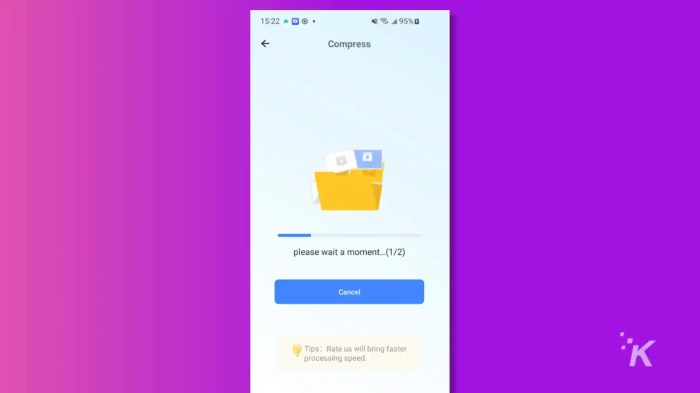
Coping with compressed recordsdata in your Android machine can typically really feel like navigating a maze. Whereas the method is normally clean, you would possibly encounter roadblocks. This part is devoted to serving to you overcome these hurdles, guaranteeing your file compression and extraction experiences are as seamless as doable. We’ll discover frequent issues, provide sensible options, and information you thru varied situations to make you a compression professional.
Figuring out Widespread Points Encountered Throughout File Compression and Extraction
Generally, issues do not go as deliberate. It is irritating while you attempt to compress or extract a file and one thing goes unsuitable. Understanding these frequent pitfalls is step one towards fixing them.
- Compression Failure: This might manifest as an error message throughout the compression course of, or a corrupted or incomplete archive. The file won’t compress in any respect, or the method could cease prematurely.
- Extraction Errors: Just like compression, extraction would possibly fail, leading to an error message or an incapability to entry the recordsdata throughout the archive. The extracted recordsdata may also be corrupted or incomplete.
- Corrupted Archives: These are recordsdata that, for varied causes, have turn into broken. They could refuse to open, or solely partially extract their contents.
- Compatibility Issues: This entails points when attempting to open a compressed file created on a special working system or utilizing a special compression format.
- File Dimension and Storage Limitations: Generally, you would possibly encounter points as a consequence of inadequate cupboard space in your machine or limitations on the scale of the recordsdata being compressed or extracted.
- Password Points: Issues can come up if you happen to overlook the password to a password-protected archive or enter it incorrectly.
Offering Options for Corrupted Compressed Recordsdata
A corrupted compressed file is usually a main headache, however all hope shouldn’t be misplaced. A number of approaches may help you recuperate or salvage your knowledge.
- Attempt Totally different Extraction Software program: Generally, a special app can deal with a corrupted archive higher than the one you initially used. Attempt utilizing a special file supervisor or a devoted archive utility. For instance, if you happen to’re having hassle with the default Android file supervisor, attempt utilizing apps like ZArchiver or RAR.
- Restore Instruments: Some compression utilities provide built-in restore capabilities. These instruments try to repair the broken archive. Search for choices like “Restore archive” or related functionalities inside your chosen app.
- Knowledge Restoration Software program (For Extreme Circumstances): If the archive is severely corrupted and also you’re determined to recuperate the information, think about using specialised knowledge restoration software program on a pc. These instruments usually make use of superior strategies to recuperate knowledge from broken recordsdata, however success is not assured. This usually entails connecting your Android machine to a pc.
- Examine for Backup Copies: This will appear apparent, however when you’ve got a backup of the unique recordsdata, that is one of the best resolution. At all times again up your necessary knowledge to stop knowledge loss. Cloud storage companies like Google Drive or Dropbox may be invaluable in these conditions.
- Contemplate the Authentic Supply: If the compressed file was downloaded, re-download it. The unique file may need been corrupted throughout the preliminary obtain.
Describing The way to Deal with Compatibility Issues with Totally different Compression Codecs
The world of compression codecs can really feel overwhelming, with differing kinds and variations. Luckily, you may take steps to navigate compatibility points.
- Perceive Widespread Codecs: Familiarize your self with frequent codecs like ZIP, RAR, 7z, and their respective capabilities. Figuring out which codecs are broadly supported may help you select the best one to your wants. ZIP is usually probably the most universally appropriate.
- Use Appropriate Software program: Make sure you’re utilizing a file supervisor or compression app that helps the precise format of the compressed file. Most trendy Android file managers deal with ZIP recordsdata with out subject. For RAR or 7z recordsdata, you would possibly want a devoted app like ZArchiver.
- Replace Your Software program: Maintain your file administration and compression apps up to date. Updates usually embody help for newer codecs and enhancements to present format dealing with.
- Convert Codecs (If Obligatory): In the event you’re coping with an uncommon format and your present app would not help it, take into account changing the file to a extra frequent format. Many on-line and offline instruments can carry out format conversions. Be conscious of safety when utilizing on-line instruments. For instance, you would possibly convert a RAR file to a ZIP file in case your main machine can solely open ZIP recordsdata.
- Examine File Extensions: Make sure that the file extension matches the precise format of the file. Generally, a file may need the unsuitable extension, resulting in compatibility issues. Rename the file to the proper extension if wanted.
Explaining What to Do If the Compression Course of Fails
Compression failures may be irritating, however do not surrender! Right here’s a troubleshooting information.
- Examine Storage House: Be sure you have sufficient free house in your Android machine to accommodate the compressed file. Inadequate storage is a standard reason behind compression failures.
- Confirm File Integrity: Make sure the recordsdata you are attempting to compress are usually not corrupted themselves. Attempt opening the recordsdata individually to examine for errors.
- Shut Different Apps: Shut different apps working within the background, as they is likely to be interfering with the compression course of. This frees up system assets.
- Restart Your Gadget: Generally, a easy restart can resolve momentary glitches that is likely to be inflicting the compression to fail.
- Attempt a Totally different Compression App: If the issue persists, attempt utilizing a special compression app. Totally different apps would possibly deal with the method in another way, and one would possibly succeed the place one other fails.
- Examine File Permissions: Guarantee you might have the mandatory permissions to learn the recordsdata you are attempting to compress and write the compressed file to the specified location.
- Keep away from Lengthy File Paths and Names: Very lengthy file paths or filenames can typically trigger points. Attempt transferring the recordsdata to an easier location or renaming them.
- Contemplate File Dimension Limitations: Some apps or file programs have limitations on the scale of recordsdata that may be compressed. In the event you’re compressing a really massive file, it is likely to be the reason for the failure.
- Contact App Assist: If all else fails, seek the advice of the documentation or contact the help group of the compression app you might be utilizing. They could have particular troubleshooting steps or pay attention to recognized points.
Superior Compression Strategies
Able to degree up your file compression sport on Android? We’re diving into some power-user tips that may considerably improve your effectivity and management over your compressed recordsdata. These strategies transcend the fundamentals, providing better flexibility and optimization. Put together to turn into a compression ninja!
Superior Compression Choices in Apps
Many third-party compression apps present superior choices that transcend merely zipping or unzipping recordsdata. These options can dramatically enhance your skill to handle and tailor your compressed archives.For instance, you would possibly discover choices for:
- Splitting Archives: Think about a large video file you need to share however are restricted by e mail attachment dimension restrictions. Splitting the archive permits you to break it down into smaller, manageable chunks. That is notably helpful for transferring massive recordsdata by way of e mail or cloud storage, the place dimension limits are frequent.
- Setting Compression Ranges: Similar to a chef has totally different settings for his or her oven, you may usually select the compression degree. Increased compression ranges (e.g., “Most” or “Extremely”) sometimes lead to smaller file sizes however require extra processing time. Conversely, decrease compression ranges (e.g., “Quick” or “Regular”) compress recordsdata extra rapidly however could lead to bigger file sizes. Discovering the best stability between velocity and compression is vital.
Contemplate this situation: You could rapidly compress a folder of pictures for a buddy. Utilizing a decrease compression degree will get the job completed quick, even when the ensuing file is a bit bigger. In the event you’re archiving a backup of necessary paperwork, a better compression degree might be price the additional wait to make sure the smallest doable file dimension.
- Password Safety: Securing your archives with passwords is a necessary function for safeguarding delicate data. This ensures that solely approved people can entry the contents of the compressed file.
Automating File Compression
Why manually compress recordsdata when you may automate the method? Utilizing scripting or activity automation apps, you may arrange your Android machine to robotically compress recordsdata primarily based on particular triggers. That is an extremely highly effective function that may prevent effort and time, particularly if you happen to commonly compress recordsdata.Let’s discover the strategies for automation:
- Process Automation Apps: Apps like Tasker (a preferred selection, though requiring a paid license) and MacroDroid are your allies right here. These apps let you create “duties” that automate actions primarily based on “triggers” and “actions.” For instance, you possibly can arrange a activity that robotically compresses all new pictures taken by your digital camera into a zipper archive each night time.
- Scripting: For extra superior customers, scripting can present better flexibility and management. You should utilize scripting languages like Python (with an appropriate interpreter) or shell scripting to automate compression duties. This entails writing a script that makes use of command-line instruments like `zip` or `7z` to compress recordsdata. Whereas scripting requires extra technical information, it provides a excessive diploma of customization.
For example the sensible utility of automation, take into account this:Think about a photographer who takes a whole lot of pictures day by day. By organising an automatic activity, they’ll guarantee all pictures are robotically compressed into a zipper archive and saved to a selected folder each night time. This protects them important time and ensures their cupboard space is effectively utilized.
Compressing Recordsdata from the Command Line
In case your Android machine is rooted, you would possibly have the ability to entry a command-line interface (CLI), permitting you to compress recordsdata instantly from the terminal. This supplies a robust, albeit extra technical, approach to handle your recordsdata.This is the way it usually works:
- Terminal Emulators: You may want a terminal emulator app, akin to Termux, which supplies a command-line setting in your Android machine.
- Command-Line Instruments: You may sometimes use instruments like `zip` or `7z` (if put in) to carry out the compression. The precise instructions will rely on the software and your required choices.
- Instance: To compress a file named “my_document.txt” into a zipper archive named “my_document.zip,” you would possibly use the next command (assuming `zip` is offered):
zip my_document.zip my_document.txt
This technique supplies unparalleled management, permitting you to script complicated compression operations and combine them with different command-line utilities. This may be particularly helpful for superior customers who have to automate repetitive duties or combine compression into a bigger workflow. Nonetheless, it is necessary to keep in mind that utilizing the command line requires a sure degree of technical experience, and incorrect instructions can probably result in knowledge loss.
File Sharing and Compression
Sharing recordsdata on Android can typically really feel like attempting to squeeze a watermelon via a keyhole – particularly when coping with massive pictures, movies, or paperwork. Compression steps in as the final word file-sharing facilitator, making the entire course of smoother and extra environment friendly. Consider it as a digital shrink ray to your recordsdata, permitting them to journey sooner and take up much less house.
Simpler File Sharing Facilitated by Compression
Compression considerably streamlines file sharing on Android. It shrinks file sizes, making them simpler to ship and obtain throughout varied platforms. Smaller recordsdata imply faster uploads and downloads, which is very helpful when utilizing cell knowledge or coping with sluggish web connections. Compression additionally helps bypass file dimension limits imposed by e mail suppliers, messaging apps, and cloud storage companies. The flexibility to share recordsdata extra effectively interprets to improved productiveness, faster communication, and a usually much less irritating consumer expertise.
Contemplate a situation the place you should share a big presentation with a colleague. Compressing the presentation earlier than sending it by way of e mail can save important time and bandwidth in comparison with sending the uncompressed file.
Compressing Recordsdata Earlier than Sharing
Earlier than sharing recordsdata, compression is an important step. You should utilize varied strategies, together with built-in file managers, third-party apps, and even options inside sure purposes like cloud storage companies. The method usually entails choosing the file(s) you want to share, selecting a compression technique (like ZIP), after which initiating the compression course of. As soon as the file is compressed, you may then share it by way of e mail, messaging apps, or cloud storage.
Bear in mind to decide on the suitable compression degree to your wants; increased compression ratios lead to smaller file sizes however may take longer to compress and decompress. A stability between file dimension and high quality must be thought-about.
File Sharing Eventualities Benefiting from Compression
Compression provides benefits in quite a few file-sharing situations.
- Sharing Giant Picture Albums: Think about you have simply returned from a trip and need to share a whole lot of pictures with your loved ones. Compressing the pictures right into a ZIP archive considerably reduces the general file dimension, making it simpler to share by way of e mail or add to cloud storage.
- Sending Excessive-Decision Movies: Sharing movies recorded in excessive decision is usually a bandwidth-intensive activity. Compressing the video earlier than sharing ensures sooner uploads and downloads, notably helpful when sharing with buddies or colleagues who may need restricted web entry.
- Distributing Paperwork and Displays: When sharing displays, stories, or different document-heavy recordsdata, compression can drastically scale back the file dimension, making it simpler to share by way of e mail or different communication channels. That is notably helpful when sending paperwork to a big group of recipients.
- Backing Up Recordsdata to Cloud Storage: Compressing recordsdata earlier than importing them to cloud storage saves priceless cupboard space and reduces the time required for the add course of. That is notably necessary when coping with massive quantities of knowledge.
Step-by-Step Information to Compress and Share a File by way of E mail:
- Choose the File: Utilizing a file supervisor app (like Recordsdata by Google), find the file you need to share.
- Compress the File: Lengthy-press the file, then choose the “Compress” or “Zip” choice from the menu. Chances are you’ll be prompted to decide on a compression degree or set a password (non-compulsory).
- Title the Archive: Present a reputation for the compressed file (e.g., “vacation_photos.zip”).
- Connect to E mail: As soon as the file is compressed, open your e mail app and create a brand new e mail.
- Connect the Compressed File: Faucet the attachment icon (normally a paperclip) and choose the compressed file (the .zip file) out of your file supervisor.
- Add Recipients and Ship: Enter the recipient’s e mail handle(es), write your message, and ship the e-mail.
